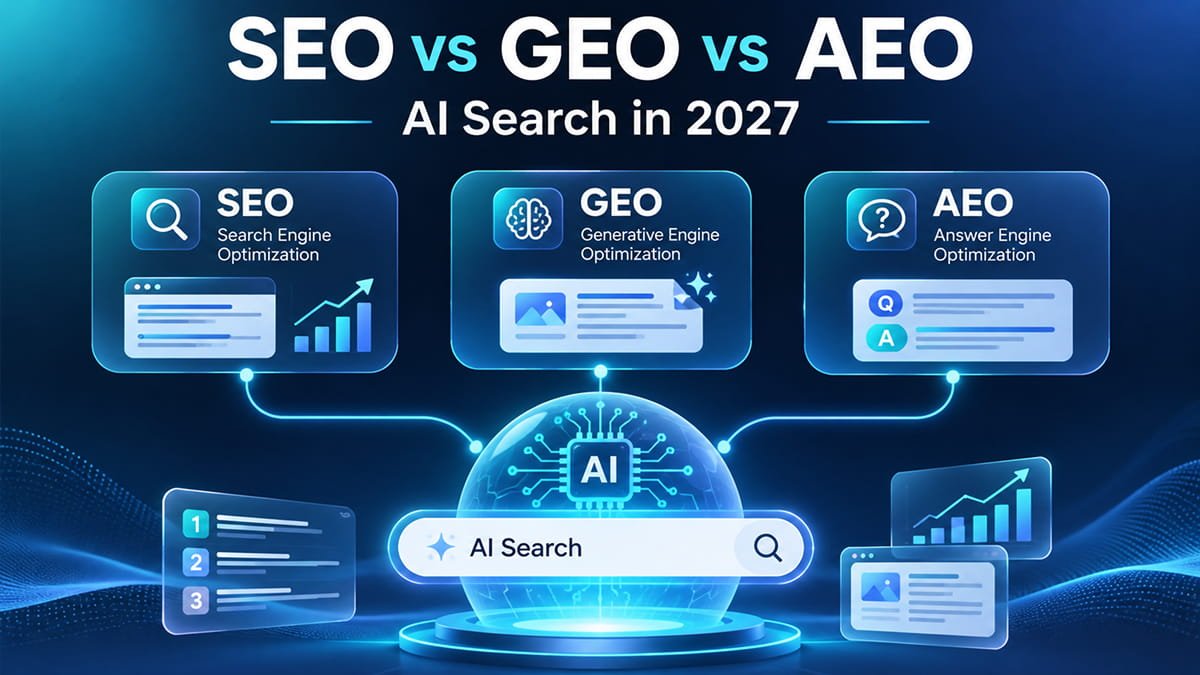
SEO, GEO, and AEO are three approaches to improving digital visibility, but they focus on different aspects of how people discover information. Search Engine Optimization (SEO) helps websites appear in traditional search results. Generative Engine Optimization (GEO) focuses on visibility in AI-generated responses. Answer Engine Optimization (AEO) makes information easier to understand and present as a direct answer to a user’s question.
For businesses preparing for 2027, the important question is not which strategy will replace the others. It is how these approaches can work together to connect a business with potential customers across traditional search engines, AI assistants, and answer-driven discovery experiences.
Google Search, ChatGPT Search, Microsoft Copilot, and Perplexity are examples of platforms where users can discover information through search, generated responses, or combinations of both.
This changes how businesses should think about content strategy, technical website optimization, brand authority, and performance measurement.
In this guide, we explain the differences between SEO, GEO, and AEO, how AI-powered search systems work, and the practical steps businesses can take to build a more resilient search visibility strategy for 2027.
Quick Answer: What Is the Difference Between SEO, GEO, and AEO?
The main difference between SEO, GEO, and AEO is the type of search experience they emphasize.
- SEO (Search Engine Optimization): Improves website visibility in organic search results through technical optimization, relevant content, and other established search best practices.
- GEO (Generative Engine Optimization): Focuses on making a business and its content discoverable, understandable, and useful as potential sources in AI-generated responses.
- AEO (Answer Engine Optimization): Focuses on providing clear, accurate, accessible answers to specific questions users ask search engines and AI assistants.
These approaches overlap significantly. They should not be treated as entirely separate technical disciplines or independent ranking systems.
In particular, Google has clarified that its existing SEO best practices remain foundational for visibility in generative AI features, including AI Overviews and AI Mode.
For most businesses, the strongest approach is an integrated strategy combining technical SEO, useful content, clear answers, credible information, and measurable business outcomes.
SEO vs. GEO vs. AEO: Side-by-Side Comparison
| Factor | SEO | GEO | AEO |
|---|---|---|---|
| Full name | Search Engine Optimization | Generative Engine Optimization | Answer Engine Optimization |
| Primary focus | Organic search visibility | Visibility in AI-generated responses | Clear answers to user questions |
| Typical discovery surfaces | Search engine results | AI search and assistant experiences | Featured answers, AI responses, conversational search |
| Content emphasis | Search intent, usefulness, relevance | Evidence, context, expertise, source credibility | Direct explanations and question-focused information |
| Technical priorities | Crawlability, indexing, performance, internal links | Accessible content, search eligibility, crawler access where applicable | Semantic structure, readable content, appropriate structured data |
| Measurement | Organic clicks, impressions, conversions | AI citations, mentions, referral traffic, conversions | Question-level visibility, answer inclusion, qualified engagement |
| Main business objective | Attract relevant organic visitors | Be discovered and considered in AI-assisted research | Help potential customers find accurate answers |
Important distinction: These categories describe strategic priorities, not three universally standardized sets of ranking factors. A technically accessible, genuinely useful page may support all three objectives simultaneously.
What Is SEO (Search Engine Optimization)?
Search Engine Optimization is the process of improving a website’s visibility in unpaid search results by making its pages technically accessible, relevant, useful, and understandable to search engines.
Traditional SEO remains an essential part of digital marketing because businesses still need search engines to discover, interpret, index, and surface their content.
The Core Components of Modern SEO
Technical SEO
Technical SEO focuses on the infrastructure supporting search visibility.
This includes:
- Crawlability and indexability
- Logical website architecture
- XML sitemaps and canonical URLs
- Internal linking
- Mobile usability and accessibility
- Page performance and Core Web Vitals
- Correct redirects and HTTP status codes
- JavaScript rendering and content accessibility
- Structured data where appropriate
Content and On-Page SEO
Content optimization helps a website address relevant search intent.
It includes descriptive page titles, meaningful headings, original explanations, relevant terminology, clear navigation, and information that fulfills the user’s needs.
Authority and Trust
Search visibility also depends on whether users and search systems have sufficient reasons to trust the information presented.
Businesses can strengthen credibility through transparent company information, verifiable expertise, accurate service descriptions, reputable references, and genuine industry recognition.
Why SEO Still Matters in 2027
AI-generated search experiences do not eliminate the need for technical foundations.
Google’s AI search features use its underlying search infrastructure and may retrieve content from indexed web pages to support generated answers.
This means a business that neglects crawlability, indexing, or content quality can create visibility problems affecting both traditional search and AI-assisted discovery.
SEO is not becoming obsolete. It is becoming part of a broader search visibility strategy.
What Is GEO (Generative Engine Optimization)?
Generative Engine Optimization is an emerging term for practices intended to improve how a business, brand, or website appears in responses produced by generative AI systems.
Unlike a traditional search results page that primarily presents links, a generative AI experience can synthesize information from multiple sources into a conversational answer.
For example, a potential customer might ask:
“What should a growing SaaS company consider when choosing a custom software development partner?”
An AI-powered search experience may provide a comparison of selection criteria, explain technical considerations, identify relevant providers, and reference external sources.
GEO addresses the opportunity for businesses to become relevant and credible within this research process.
How Generative AI Search Works
Some AI-powered search systems use a technique called Retrieval-Augmented Generation (RAG).
In simplified terms, the process can involve:
- Interpreting the user’s question and intent.
- Retrieving relevant information from search indexes or other available sources.
- Evaluating and combining information from those sources.
- Generating a response grounded in retrieved information.
- Presenting references, citations, or links when supported by the platform.
Google also describes a technique called query fan-out, in which a complex question can lead to multiple related searches that help build a more comprehensive answer.
However, not all AI assistants retrieve information the same way. Some responses may rely on previously learned information, while others use live web retrieval, indexed documents, or additional tools.
There is no universal algorithm that determines how every generative system selects or cites sources.
What Makes Content Useful for GEO?
Effective GEO begins with information that is worth referencing.
Consider a business publishing an article about custom software development costs.
A generic article might simply state that project costs depend on complexity.
A more useful resource could explain:
- How project scope affects development effort
- Differences between an MVP and a production-ready platform
- The cost implications of third-party integrations
- Infrastructure, security, and maintenance requirements
- Common architectural trade-offs
- Which assumptions should be validated before estimating a budget
The second resource provides more concrete information for both readers and systems retrieving information about the topic.
It is also more likely to support informed purchasing decisions.
GEO Is Not About Manipulating AI Responses
There is no credible method to guarantee that ChatGPT, Google AI Overviews, Gemini, Copilot, or Perplexity will recommend a particular business.
Repeated brand mentions, artificially generated content, or unsupported authority claims do not create a dependable AI visibility strategy.
A sustainable approach focuses on accessible information, verifiable facts, original expertise, and genuine relevance to the user’s question.
What Is AEO (Answer Engine Optimization)?
Answer Engine Optimization is the practice of making content useful for systems that respond directly to questions.
AEO emphasizes answer clarity, accuracy, and the alignment between a question and the information provided.
Although the term has gained attention alongside AI search, the underlying concept predates modern generative AI assistants.
Search engines have long displayed featured snippets, knowledge panels, and other formats that answer questions directly.
AI-powered conversational systems have expanded the importance of well-structured, understandable explanations.
Example of AEO-Optimized Content
Imagine a visitor asks:
“What is the difference between a web application and a website?”
A weak answer might say:
“We specialize in building innovative digital experiences using modern technologies.”
This does not answer the question.
A better answer would be:
“A website primarily presents information to visitors, while a web application enables users to perform interactive tasks, such as managing accounts, processing transactions, or working with business data. Many modern digital products combine both capabilities.”
The second answer immediately addresses the question and provides enough context to be useful.
Additional sections can then explore architecture, user authentication, databases, integrations, scalability, and development costs.
Practical AEO Content Principles
An answer-focused content structure should:
- Use descriptive headings that reflect real user questions.
- Give a direct answer before expanding into technical detail.
- Explain important terms without unnecessary jargon.
- Provide examples that clarify the explanation.
- Address relevant follow-up questions.
- Distinguish established facts from estimates and opinions.
- Keep information accurate and current.
FAQ sections can support this approach when they address genuine customer questions.
However, adding FAQ schema does not automatically make a page appear in AI-generated answers, and Google generally restricts FAQ rich results to eligible authoritative government and health websites.
AEO is primarily about making information valuable and understandable—not adding special markup to every page.
How SEO, GEO, and AEO Work Together
The most effective way to understand the relationship between these strategies is through a practical business example.
Consider a company offering custom web application development.
A prospective customer could search for:
Traditional search query:
“Custom web application development company”
SEO helps the company’s service page compete for relevant organic visibility.
AI-assisted research question:
“How do I choose a reliable development partner for a complex B2B web application?”
GEO focuses on making the business’s expertise, services, and relevant resources discoverable during AI-assisted research.
Specific informational question:
“Should I use microservices or a monolithic architecture for my SaaS MVP?”
AEO encourages a direct, technically accurate answer explaining the trade-offs, rather than promoting one architecture without context.
One business can serve all three needs through an interconnected content system.
For example, a custom software development service page can link to articles about SaaS architecture, API integration, MVP planning, and software maintenance.
Those articles can answer detailed questions while helping establish meaningful topical coverage.
The service page then connects educational discovery with a relevant commercial offering.
The objective is not merely to appear in search results. It is to help potential customers move from research to informed action.
Why AI Search Changes the Customer Journey
Traditional search often follows a relatively familiar sequence:
A user enters a query, examines search results, visits websites, compares information, and eventually contacts a provider.
AI-assisted research can introduce additional steps or consolidate several of them.
A user might ask an AI assistant to compare solutions, clarify requirements, identify potential risks, and summarize possible vendors before visiting any website.
This creates three important considerations for businesses.
1. Discovery Can Happen Before a Website Visit
A company might be mentioned or referenced during a research session without immediately receiving a website visit.
This makes visibility more difficult to evaluate using organic traffic alone.
At the same time, a mention without a click is not automatically a business success.
Companies still need to determine whether AI visibility contributes to relevant inquiries, qualified leads, or revenue.
2. Specific Expertise Becomes More Useful
Broad claims such as “we provide high-quality digital solutions” offer little information that helps customers evaluate a provider.
Specific explanations of capabilities, processes, constraints, and relevant use cases give potential customers more substance to assess.
For B2B technology companies, this may involve content covering software architecture, integration requirements, security, deployment, maintenance, and technical decision-making.
3. Brand Consistency Matters Across Sources
Potential customers can encounter a business through its website, external publications, directories, professional profiles, reviews, and AI-generated summaries.
Accurate and consistent company information helps reduce confusion.
Businesses should keep their public descriptions, service offerings, contact information, and relevant organizational details current.
This does not guarantee that AI models will represent the business correctly, but it creates a clearer public information footprint.
How to Optimize Your Website for SEO, GEO, and AEO in 2027
Businesses should start with practical improvements that support discoverability, understanding, and conversions rather than chasing speculative AI optimization shortcuts.
1. Build a Strong Technical SEO Foundation
Before expanding your AI search strategy, verify that your website is technically accessible.
Review whether important pages can be crawled and indexed, internal links work correctly, canonical URLs are consistent, and your site avoids unnecessary rendering dependencies.
Check how the website behaves with JavaScript disabled or delayed, particularly if critical content depends on client-side execution.
Also review server logs, hosting restrictions, and security tools that may block legitimate crawlers.
Technical checklist:
- Important pages return valid HTTP responses.
- Valuable content is accessible in readable HTML.
- Internal links use crawlable destinations.
- Canonical tags identify preferred URLs.
- XML sitemaps contain the correct canonical URLs.
- Key pages are not accidentally marked
noindex. - Page performance and mobile usability are maintained.
- Search crawlers are not unintentionally blocked by firewalls.
For ChatGPT Search specifically, OpenAI documents OAI-SearchBot as its search-related crawler. Its controls are separate from those associated with the GPTBot training crawler.
Businesses should understand those differences before changing their robots.txt policies.
2. Create Content Around Real Customer Questions
Keyword research remains valuable, but content planning should go beyond isolated phrases.
Consider the questions potential customers ask before selecting a provider.
For a software development agency, these could include:
- How much does custom SaaS development cost?
- When should a business build custom software instead of using an existing platform?
- What are the risks of integrating multiple third-party APIs?
- How should a company evaluate software scalability?
- What should be included in an MVP development scope?
- How do businesses maintain security in customer-facing web applications?
Each question represents an opportunity to demonstrate expertise while supporting a stage of the buying journey.
Focus on questions that align with your services, technical knowledge, and commercial relevance.
3. Publish Original, Evidence-Based Information
AI search optimization should not become an excuse to publish hundreds of interchangeable articles.
Information becomes more valuable when it contributes something specific.
Depending on your business, that could include:
- Original technical explanations
- Product demonstrations
- Documented implementation processes
- Real examples with appropriate permissions
- Transparent comparisons
- Practical decision frameworks
- Verified benchmarks or research
- Lessons supported by actual experience
Where claims depend on external research, reference the original source.
Where pricing or technical recommendations vary, explain the assumptions and limitations.
A resource that helps customers make a decision has more business value than one that simply repeats popular search phrases.
4. Structure Content for Readability and Direct Answers
Use a logical heading hierarchy and make each section address a clear topic.
For important questions, a useful pattern is:
Question → Direct answer → Explanation → Example → Next step
For example:
Question: How long does it take to develop a custom web application?
Direct answer: Development timelines vary depending on product scope, architecture, integration requirements, and quality assurance. A limited MVP generally requires less work than a complex production platform with multiple user roles and external integrations.
Explanation: Discovery, design, backend development, frontend development, testing, and deployment all affect the schedule.
Next step: Prepare a prioritized feature list and technical requirements before requesting an estimate.
This structure helps readers find relevant information without searching through unrelated material.
It can also make the content easier for retrieval systems to interpret, although no particular formatting pattern guarantees AI citations.
5. Use Structured Data Where It Accurately Describes the Page
Schema.org markup helps represent information in a machine-readable format.
Depending on the content, relevant types can include:
OrganizationWebSiteWebPageArticleorBlogPostingBreadcrumbListLocalBusinessfor eligible local businessesProductor other supported types where genuinely applicable
Structured data should match information visible on the page.
It should not contain fabricated reviews, invented ratings, misleading service claims, or unsupported credentials.
Google does not require special GEO, AEO, or AI-specific structured data to appear in AI Overviews or AI Mode.
Treat schema markup as a semantic and search enhancement—not a shortcut into AI-generated recommendations.
6. Strengthen Brand and Entity Clarity
Search systems benefit from clear information about what a business is, what it offers, and how it relates to relevant topics.
A company website should communicate:
- Its official business name
- Core services and specializations
- Markets or service areas
- Relevant expertise
- Contact and company information
- A clear explanation of its offerings
- Trustworthy supporting evidence where available
For a technology agency, a dedicated service page should explain actual capabilities rather than rely only on broad labels such as “digital solutions.”
For example, a custom web application development page might describe user authentication, workflow automation, API integration, data management, and scalable application architecture—provided these capabilities are genuinely offered.
Build supporting articles around related problems, but avoid creating multiple near-duplicate pages simply to target keyword variations.
7. Earn Relevant External References
External visibility can support brand discovery and credibility.
Useful opportunities may include industry publications, technical contributions, genuine partnerships, expert interviews, professional communities, and reputable business listings.
The goal should be to contribute information that is relevant and worth referencing.
Avoid purchasing artificial mentions or publishing low-quality articles across unrelated websites solely to increase brand repetition.
External exposure is most valuable when it connects a business with a relevant audience and provides credible context.
8. Optimize for Conversion, Not Only Visibility
Getting discovered is only one part of customer acquisition.
A website must also help visitors understand whether the business can solve their problem.
Service pages should communicate:
- Who the service is for
- Which business problems it addresses
- What the engagement may include
- Relevant technical or operational considerations
- How the process works
- What information is needed to get started
- A clear next step
For B2B services, a useful call to action could be:
“Discuss your project requirements and identify the right technical approach before committing to development.”
This connects informational content with a realistic business outcome.
Measuring SEO, GEO, and AEO Performance
A broader search strategy needs more than one performance metric.
Traditional SEO reporting remains important, but AI-assisted discovery introduces additional measurements.
| Metric | What It Helps Evaluate |
|---|---|
| Organic impressions | Traditional search visibility |
| Organic clicks | Traffic from organic search |
| Search queries | Topics and intent associated with search exposure |
| Indexed pages and crawl issues | Technical accessibility |
| AI citations | When content is visibly referenced in supported AI experiences |
| AI brand mentions | Whether the business appears in tested AI responses |
| AI referral traffic | Visits attributed to identifiable AI platforms |
| Qualified leads | Whether discovery produces relevant inquiries |
| Conversion rate | How effectively relevant visitors become leads or customers |
| Revenue contribution | Commercial value of search-related acquisition |
Tools for Monitoring AI Search Visibility
Google Search Console
Use Search Console to assess indexing, query visibility, search performance, and technical issues. Where available, review Google’s reporting for generative AI search performance.
Bing Webmaster Tools
Microsoft’s AI Performance reporting provides information about citations and referenced pages across supported Copilot, Bing, and partner experiences. It also includes visibility into grounding queries.
Web Analytics
Use analytics tools to review identifiable referral traffic from AI platforms, relevant landing pages, and completed conversions.
Structured AI Search Testing
Maintain a consistent set of commercially relevant questions and periodically assess whether your business is mentioned, cited, or accurately represented across selected AI search platforms.
Because AI responses can change between sessions, locations, and model versions, individual prompt results should not be treated as definitive rankings.
The Most Important Measurement Principle
A citation is not a click, a brand mention is not a lead, and visibility is not automatically revenue.
Track AI-related visibility alongside commercial outcomes.
This prevents businesses from optimizing for impressive-looking reporting metrics that do not contribute to customer acquisition.
Common SEO, GEO, and AEO Mistakes to Avoid
Mistake 1: Treating GEO as a Replacement for SEO
If your website has crawlability problems, weak content, or poor information architecture, creating an isolated GEO strategy will not resolve those issues.
Start with strong SEO fundamentals.
Mistake 2: Publishing Content Only for AI Systems
Content should help real customers make decisions.
Artificially repetitive articles, unsupported claims, and unnecessary formatting tricks can reduce usefulness.
Mistake 3: Assuming Schema Guarantees AI Citations
Structured data can help describe content, but it does not control whether an AI system selects a source.
Mistake 4: Treating AI Visibility as a Single Ranking
AI responses are contextual and can vary substantially.
A business may appear for one question and not another, even when the questions are related.
Mistake 5: Ignoring Technical Crawler Access
Security services, robots.txt rules, and server configurations can restrict access to public website content.
Investigate unintended restrictions while maintaining appropriate security and content-use policies.
Mistake 6: Measuring Mentions Without Business Impact
Track whether AI-assisted discovery contributes to relevant inquiries, conversions, and customer relationships.
Mistake 7: Buying Into Guaranteed AI Search Rankings
No agency can legitimately promise permanent recommendations or citations across independent AI search platforms.
Optimization can improve discoverability and content quality, but placement remains controlled by each platform.
SEO, GEO, and AEO Strategy: A Practical 90-Day Roadmap
Businesses do not need to rebuild their entire websites to begin preparing for AI-driven search.
A focused implementation plan can identify the highest-value opportunities first.
Days 1–30: Technical and Visibility Audit
Start by understanding the current situation.
Review technical SEO, indexability, existing organic traffic, page structure, and conversion performance.
Audit your most important service pages and identify high-intent customer questions that are insufficiently addressed.
Also review supported AI search experiences to establish a directional baseline of your current brand visibility.
Deliverables:
- Technical SEO audit
- Search visibility baseline
- Priority service page review
- AI discovery assessment
- Content opportunity map
Days 31–60: Content and Website Improvements
Prioritize existing pages with strong business relevance.
Improve clarity, answer important customer questions, strengthen internal linking, and correct technical accessibility issues.
Publish a small number of substantial supporting resources based on real customer needs.
Update relevant structured data and ensure public company information is consistent.
Deliverables:
- Improved commercial landing pages
- Relevant supporting articles
- Updated internal linking
- Technical fixes
- Structured data validation
Days 61–90: Authority, Measurement, and Refinement
Review early performance data and investigate whether the improvements contribute to more relevant discovery.
Look for credible opportunities to contribute expertise externally.
Evaluate AI citations and mentions where measurable, but assess them alongside website engagement and lead quality.
Refine content based on real questions, observed gaps, and commercial priorities.
Deliverables:
- Search and AI visibility reporting
- Content refinement backlog
- Relevant authority-building opportunities
- Conversion performance review
- Next-quarter optimization priorities
The goal of the first 90 days is to establish a technically sound, commercially relevant foundation—not to promise immediate AI search rankings.
What Will Matter Most for AI Search in 2027?
The exact direction of AI search in 2027 cannot be predicted with certainty.
Search engines and AI platforms may continue changing their interfaces, retrieval methods, reporting tools, and commercial experiences.
However, several priorities are already practical for businesses preparing for that environment.
Strong Technical Foundations
Websites need to remain accessible, secure, usable, and understandable to search systems.
Demonstrable Expertise
Original explanations and evidence-backed information provide more value than generic descriptions.
Clear Answers to Commercial Questions
Businesses should address the questions customers ask before choosing a solution or provider.
Consistent Brand Information
Public information should accurately explain what the company offers and how customers can engage with it.
Better Measurement
Traditional search traffic should be assessed alongside relevant AI citations, referral traffic, lead quality, and conversion performance.
Readiness for AI-Assisted Actions
AI agents are also beginning to interact with websites and digital services, not simply summarize them.
Over time, businesses may need to consider how easily authorized agents can navigate interfaces, understand products, and complete supported workflows.
For now, this is a developing area rather than a reason to replace reliable website architecture with speculative integrations.
Frequently Asked Questions About SEO, GEO, and AEO
What is the main difference between SEO, GEO, and AEO?
SEO focuses on organic search visibility, GEO emphasizes discoverability within AI-generated responses, and AEO focuses on providing direct, accurate answers to user questions. They overlap and are most effective when supported by strong technical foundations and useful content.
Is GEO replacing SEO in 2027?
No. GEO is not replacing SEO. Traditional SEO practices remain important because many AI search experiences depend on searchable, accessible, relevant web content. Businesses should integrate GEO considerations into a broader SEO strategy rather than abandon existing optimization.
What is AI search optimization?
AI search optimization refers to improving how a website, brand, or its content can be discovered and represented through AI-powered search experiences. It generally involves technical accessibility, accurate information, expert-led content, clear answers, and visibility measurement.
How can a business appear in ChatGPT Search?
A business can improve its eligibility for ChatGPT Search discovery by maintaining accessible, useful public content and reviewing whether OAI-SearchBot is permitted to crawl the website. However, allowing the crawler does not guarantee indexing, citations, or recommendations.
Does structured data improve GEO and AEO?
Relevant structured data can help systems interpret information about a page and its entities. However, there is no universal schema markup that guarantees inclusion in AI answers. Structured data should accurately reflect visible content and follow applicable search engine guidelines.
Is AEO the same as featured snippet optimization?
Not exactly. Featured snippet optimization is a narrower practice focused on specific search result presentations. AEO is a broader term for making information suitable for question-answering experiences, including conversational AI interfaces.
Can AI-generated content rank in Google?
AI-assisted content is not automatically excluded from Google Search. Its usefulness, accuracy, originality, and compliance with search policies matter. Mass-producing low-value pages to manipulate search rankings can violate Google’s spam policies.
How do you measure GEO performance?
GEO performance can be assessed through available AI citation reporting, brand mention observations, identifiable AI referral traffic, and resulting business conversions. Because platforms expose different levels of information, there is no single universal GEO ranking metric.
Do small businesses need GEO and AEO?
Small businesses can benefit from ensuring their services, expertise, and frequently asked questions are accurately represented online. The starting point should be effective SEO, clear service information, and useful answers rather than expensive standalone AI optimization tactics.
Which is more important in 2027: SEO, GEO, or AEO?
For most businesses, foundational SEO should come first. GEO and AEO can then help guide content development, brand discoverability, and answer-focused communication. Priorities should depend on the business model, audience, competitive environment, and measurable acquisition opportunities.
Final Thoughts: Build Search Visibility Beyond Traditional Rankings
SEO, GEO, and AEO are not competing solutions to three unrelated problems.
They are overlapping ways to address one increasingly important business challenge: helping potential customers discover relevant, trustworthy information across different search experiences.
SEO provides the technical and content foundation.
GEO extends the strategy toward AI-assisted research and generated responses.
AEO encourages businesses to communicate clearly and answer customer questions directly.
As 2027 approaches, businesses should focus less on optimization labels and more on the underlying objectives: technical accessibility, credible expertise, useful information, accurate brand representation, and measurable customer acquisition.
Companies that invest in these fundamentals will be better prepared to adapt as traditional search and AI-powered discovery continue evolving.
Prepare Your Business for AI-Powered Search with Ace Web Agency
At Ace Web Agency, we approach search visibility as a combination of technical infrastructure, content strategy, user experience, and business performance.
Our SEO and AI search optimization services focus on identifying technical barriers, improving website structure, strengthening service content, and creating a clearer foundation for organic and AI-assisted discovery.
Whether your business needs a technical SEO audit, improved website architecture, or a practical GEO strategy, we can help identify the opportunities worth prioritizing.
Want to understand how prepared your website is for AI search in 2027?
Contact Ace Web Agency to discuss your website, current search visibility, and optimization priorities.