The Future of Search Is Already Here
For years, businesses focused almost exclusively on ranking in Google’s traditional search results. While search engine optimization (SEO) remains essential, the way people discover information is rapidly evolving.
Today, millions of users ask questions directly to AI assistants such as ChatGPT, Google Gemini, Perplexity, Claude, and Microsoft’s Copilot instead of clicking through multiple search results.
Rather than showing a list of websites, these platforms generate complete answers by analyzing trusted sources across the web.
This shift introduces a new challenge—and opportunity—for businesses.
If your website isn’t optimized for AI-powered search, your competitors may become the sources these assistants recommend instead.
This is where AI Search Optimization (AISO) and Generative Engine Optimization (GEO) come into play.
What Is AI Search Optimization?
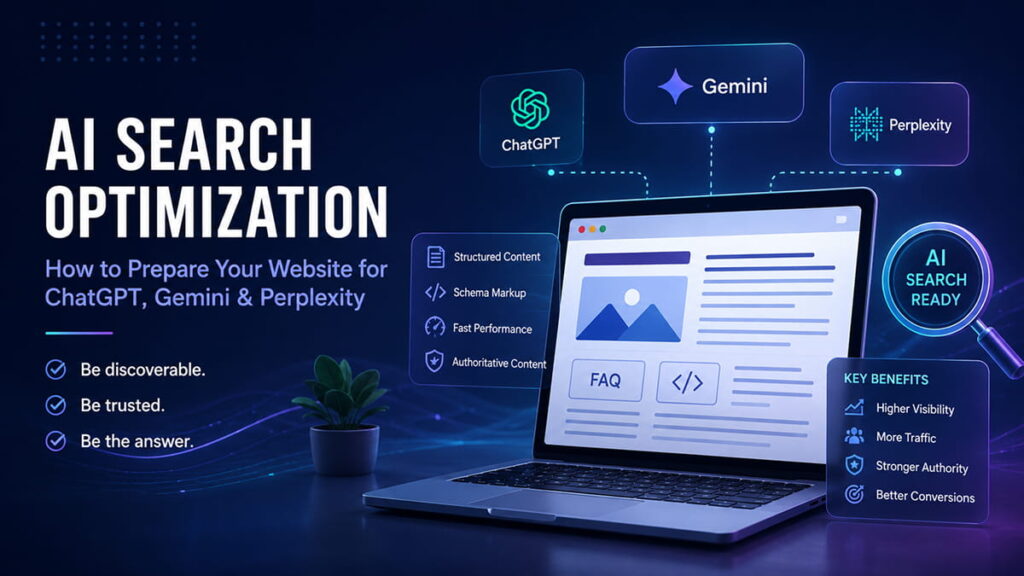
AI Search Optimization is the process of structuring your website so artificial intelligence platforms can easily understand, trust, and reference your content when generating answers.
Unlike traditional SEO, where success depends on ranking for keywords, AI search focuses on:
- Context
- Expertise
- Authority
- Structured information
- Semantic relationships
- User intent
Instead of asking:
“How do I rank #1 on Google?”
Businesses should now ask:
“How do I become the best answer AI wants to cite?”
Why AI Search Matters for Small Businesses
Large companies no longer have an automatic advantage.
AI systems often prioritize the most useful, trustworthy, and relevant content—not simply the biggest brands.
For small businesses, this creates an opportunity to compete by publishing genuinely helpful, experience-driven content.
Benefits include:
- Increased organic visibility
- More qualified website visitors
- Greater brand authority
- Better lead generation
- Higher trust with potential customers
- Future-proof digital marketing
How ChatGPT, Gemini, and Perplexity Choose Sources
Although every AI platform uses different technologies, they all tend to reward websites that demonstrate:
Clear Expertise
Your content should answer real questions using practical knowledge rather than generic marketing copy.
Strong Website Authority
Signals include:
- High-quality backlinks
- Brand mentions
- Customer reviews
- Industry recognition
- Consistent publishing
Well-Structured Content
AI systems understand pages more easily when they include:
- Clear headings (H1–H3)
- Short paragraphs
- Bullet lists
- Tables
- FAQs
- Definitions
Good structure improves readability for both humans and AI.
Up-to-Date Information
Outdated articles are less likely to be referenced.
Review important pages regularly to:
- Update statistics
- Replace outdated screenshots
- Add new examples
- Improve recommendations
Fresh content demonstrates ongoing expertise.
8 Ways to Optimize Your Website for AI Search
1. Create Helpful, Comprehensive Content
Don’t write articles solely to target keywords.
Instead, answer every question your audience may have.
For example, instead of writing:
“WordPress SEO Tips”
Create a complete resource covering:
- Technical SEO
- Content optimization
- Site speed
- Schema markup
- Internal linking
- AI search readiness
Comprehensive content is more likely to become an authoritative reference.
2. Use Structured Data (Schema Markup)
Schema helps search engines and AI understand your website.
Depending on your business, consider adding:
- Organization
- LocalBusiness
- Service
- Article
- FAQPage
- BreadcrumbList
- Person
- Review
- Product
Structured data improves machine readability and supports rich search results.
3. Build Topical Authority
Instead of publishing unrelated blog posts, organize your content into topic clusters.
Example for a web design agency:
Pillar Page
Website Design
Supporting Articles
- WordPress Development
- Squarespace Development
- Local SEO
- Technical SEO
- Core Web Vitals
- Website Speed
- AI Search Optimization
- Conversion Rate Optimization
This helps AI understand your expertise within a specific subject.
4. Write for Questions, Not Just Keywords
AI assistants answer questions.
Your content should do the same.
Examples include:
- How much does a website cost?
- Is Squarespace good for SEO?
- Should I choose WordPress or Squarespace?
- What is Schema Markup?
- How can I improve website speed?
Question-based content is highly effective for AI-powered search.
5. Demonstrate Experience
Google’s EEAT framework emphasizes:
- Experience
- Expertise
- Authoritativeness
- Trustworthiness
Include:
- Case studies
- Before-and-after examples
- Client results
- Original research
- Real screenshots
- Practical insights
Original content is significantly more valuable than AI-generated summaries alone.
6. Improve Technical Performance
Fast, secure websites are easier for search engines and AI systems to crawl.
Focus on:
- Core Web Vitals
- Mobile responsiveness
- HTTPS
- Clean code
- Optimized images
- Logical internal linking
Technical SEO remains a foundation of AI visibility.
7. Publish FAQs
Frequently Asked Questions naturally match how people interact with AI assistants.
For example:
Is AI Search replacing Google?
No. Traditional search remains important, but AI-powered search is becoming a major discovery channel.
Does Schema improve AI visibility?
Schema doesn’t guarantee citations, but it makes your content easier for AI systems to interpret.
Can small businesses compete?
Absolutely. Helpful, trustworthy content often outperforms larger competitors with weaker informational resources.
8. Build a Recognizable Brand
AI increasingly evaluates brands rather than isolated pages.
Increase your authority by:
- Publishing expert articles
- Appearing on podcasts
- Earning media mentions
- Collecting reviews
- Maintaining active social profiles
- Creating original resources
Brand recognition strengthens long-term visibility.
Common AI Search Optimization Mistakes
Avoid these common issues:
- Publishing thin articles
- Keyword stuffing
- Duplicate content
- Outdated information
- Missing Schema markup
- Weak internal linking
- Slow website performance
- Generic AI-written content without expert review
Quality consistently outperforms quantity.
Traditional SEO vs AI Search Optimization
| Traditional SEO | AI Search Optimization |
|---|---|
| Keyword rankings | Answer relevance |
| Backlinks | Authority and trust |
| Search intent | Conversational intent |
| Individual pages | Topical expertise |
| SERP clicks | AI citations and mentions |
| Search engines | AI assistants and search engines |
The strongest digital strategies now combine both approaches.
The Future of Search
AI assistants will continue changing how users discover businesses.
Rather than replacing SEO, AI expands it.
Businesses that invest today in structured, authoritative, user-focused content will be significantly better positioned as AI search continues to grow.
The question is no longer whether AI will influence search.
It’s whether your business will become one of the sources AI chooses to recommend.
Final Thoughts
AI Search Optimization isn’t about chasing algorithms—it’s about creating genuinely useful content that demonstrates expertise, builds trust, and answers real questions.
For small businesses, this presents an unprecedented opportunity to compete with larger brands by focusing on quality rather than size.
The websites that consistently publish valuable content, implement strong technical SEO, use structured data, and build topical authority will be the ones AI platforms recommend most often.
If you’re planning a new website or improving an existing one, now is the perfect time to optimize not only for Google—but also for the next generation of AI-powered search.