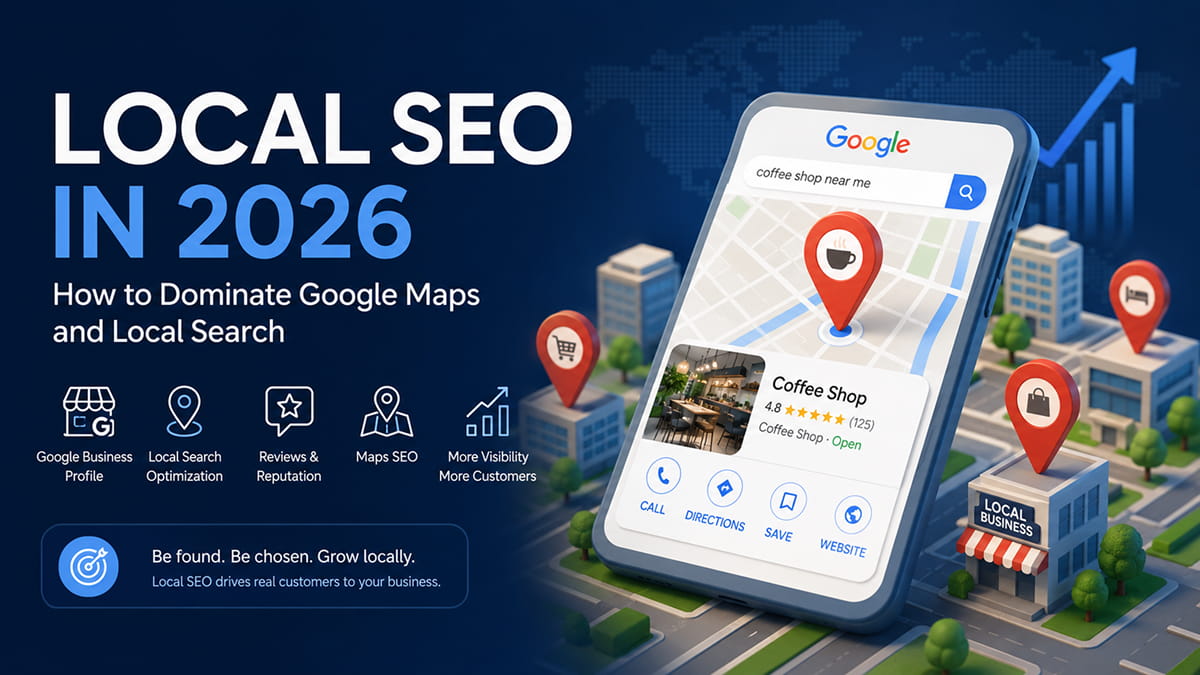
For local businesses, being visible online is no longer just about ranking on the first page of Google. Customers increasingly discover companies through Google Maps, the local pack, “near me” searches, AI-generated answers, voice assistants, and other location-aware search experiences.
That makes Local SEO one of the most valuable digital marketing strategies for businesses that serve customers in specific geographic areas.
Whether you operate a dental practice, law firm, restaurant, construction company, home service business, retail store, agency, or multi-location brand, your goal is simple: make it easy for search engines and AI systems to understand who you are, what you offer, where you operate, and why customers should trust you.
This guide explains how Local SEO works in 2026, how to improve your Google Business Profile, and how to build a local search presence designed for Google Search, Google Maps, AI Overviews, AI Mode, and generative search engines.
What Is Local SEO?
Local SEO is the process of optimizing a business’s online presence to increase its visibility for searches connected to a specific geographic area.
Instead of targeting broad searches such as:
- “web design company”
- “estate lawyer”
- “Italian restaurant”
Local Business SEO focuses on location-sensitive queries such as:
- “web design company in Chicago”
- “estate lawyer near me”
- “Italian restaurant downtown”
- “best roofing company in Austin”
- “emergency plumber open now”
Google can display different results depending on the user’s query, location, device, search history, and other contextual signals.
For businesses serving specific cities or regions, this creates an opportunity that traditional organic SEO alone cannot fully address.
Why Local SEO Matters More in 2026
The local search journey has become increasingly fragmented.
A potential customer may discover a business without ever starting with its website. They might first encounter it through:
- Google Maps
- Google Business Profile
- Google’s local pack
- AI Overviews
- AI Mode
- voice search
- review platforms
- business directories
- social platforms
- generative AI search engines
As search becomes more conversational, people are also using increasingly specific queries.
Instead of searching only for:
“SEO company Boston”
someone might ask:
“What is the best SEO company for a small local business in Boston?”
Or:
“Which web development agencies near Boston specialize in WordPress and technical SEO?”
This shift makes entity clarity, topical relevance, geographic relevance, reputation, structured information, and trustworthy third-party mentions increasingly important.
A strong Local SEO strategy in 2026 should therefore optimize not only for rankings, but also for how clearly your business can be understood across the broader search ecosystem.
How Does Google Rank Businesses in Local Search?
Google identifies three primary factors behind local rankings:
1. Relevance
Relevance represents how closely a business matches what the user is looking for.
If someone searches for an “emergency HVAC repair company,” Google needs enough information to understand whether your company actually provides emergency HVAC repair.
Your website, Google Business Profile, categories, services, content, and other business information all contribute to this understanding.
2. Distance
Google considers the distance between the searcher and potential businesses.
For searches containing a location, such as “dentist in Brooklyn,” the specified geographic area provides an obvious signal.
For searches such as “dentist near me,” Google can use available location information to determine which businesses are geographically relevant.
This is one reason why Maps SEO cannot guarantee identical rankings across an entire city. A company may rank strongly from one neighborhood and appear much lower from another.
3. Prominence
Prominence reflects how well-known and established a business is.
Signals can include reviews, links, mentions, citations, and other information Google can discover about the business online.
A strong local brand therefore has an advantage that cannot always be replicated simply by adding more keywords to a page.
1. Optimize Your Google Business Profile
Your Google Business Profile (GBP) should be one of the foundations of your Local SEO strategy.
Start by making sure every important field is complete and accurate.
Your profile should include:
- correct business name
- primary business category
- relevant secondary categories
- accurate address or service area
- phone number
- website
- business hours
- services
- products, where applicable
- business description
- attributes
- high-quality photos
- appropriate booking or contact options
Accuracy matters.
Your Google Business Profile should represent the business as it exists in the real world.
Avoid adding keywords to your business name unless those words are genuinely part of your official business name. Keyword-stuffed names can violate Google Business Profile guidelines and create unnecessary risk.
Choose the Right Primary Category
Your primary category helps Google understand what type of business you operate.
Choose the most specific category that accurately represents your core business, rather than trying to select categories simply because they contain attractive keywords.
Secondary categories can then describe other significant areas of the business.
For example, a company whose primary service is web design might use its most accurate available web-design category as the primary category and appropriate related categories for additional services.
The objective is not to include as many categories as possible.
The objective is to describe the business accurately.
2. Build Strong Local Landing Pages
If your company legitimately serves multiple locations, dedicated local landing pages can significantly expand organic search visibility.
For example:
/web-design-chicago/
/web-design-houston/
/web-design-phoenix/
However, simply duplicating the same page and replacing the city name is not a strong Local SEO strategy.
Every important location page should provide unique local value.
A strong local landing page can include:
- location-specific H1
- unique introduction
- services available in that market
- information about customers you serve locally
- relevant industries in the area
- local projects or case studies
- testimonials from relevant customers
- service process
- local considerations
- location-specific FAQ
- strong conversion CTA
- relevant internal links
For example, a web development page targeting Chicago should explain why its services are relevant to businesses operating in Chicago rather than repeating a generic web development page with “Chicago” inserted into every heading.
Avoid Doorway-Style Location Pages
Creating dozens or hundreds of thin pages targeting cities where you have no meaningful business presence or unique information can create low-value content.
Quality beats scale.
If you target 20 cities, aim to create 20 genuinely useful pages—not one page copied 20 times.
3. Keep Your Business Information Consistent
Search engines build their understanding of a local business from multiple sources.
Your core business details should therefore be accurate across your website, Google Business Profile, major directories, industry platforms, and other authoritative sources.
Important information includes:
Name, Address, Phone Number, Website, and Business Hours.
Small formatting differences are not necessarily catastrophic. The bigger concern is conflicting information.
If one platform lists an old address, another displays an outdated phone number, and your website provides different opening hours, you are creating unnecessary ambiguity for both customers and search systems.
Audit your most important business listings periodically and correct outdated information.
4. Build a Strong Review Strategy
Reviews are valuable for far more than reputation management.
They help potential customers understand what working with your company is actually like and can contribute to your overall local prominence.
Instead of treating reviews as a one-time campaign, make review generation part of your customer workflow.
For example:
Service completed → follow-up → review request → response → ongoing reputation monitoring
Encourage real customers to leave honest feedback.
Never manufacture reviews or attempt to manipulate ratings.
Respond to Reviews
Responses demonstrate that the business is active and engaged with its customers.
A good response should be natural and relevant to the actual review.
Avoid forcing keywords into every reply.
Instead of:
“Thank you for choosing the best plumbing company in Miami for Miami plumbing services.”
write something a real business owner would naturally say.
Search optimization should never make communication sound robotic.
5. Strengthen Your Website’s Local Relevance
Your website and Google Business Profile should support the same understanding of the business.
Make your geographic relevance clear through appropriate content.
Depending on the business, this can include:
- city and region information
- physical location
- service areas
- local phone information
- directions
- location pages
- local testimonials
- local case studies
- projects
- service-area information
- locally relevant FAQ
- nearby landmarks when genuinely useful
Do not simply repeat the city name dozens of times.
Google needs context—not keyword stuffing.
For example, instead of writing:
“Our Dallas SEO company provides Dallas SEO services for Dallas businesses looking for Dallas SEO.”
write:
“We help businesses across Dallas improve their visibility in organic search and Google Maps through technical SEO, content optimization, local landing pages, and Google Business Profile management.”
The second version communicates the same topic naturally while providing significantly more semantic context.
6. Create Local Content That Demonstrates Experience
One of the best ways to differentiate your business from generic competitors is through original, experience-based content.
Create resources that could realistically come only from someone familiar with your business, customers, or market.
Examples include:
“How Much Does a Kitchen Remodel Cost in Austin in 2026?”
“Commercial Building Regulations New York Businesses Should Know”
“Best Website Features for Chicago Law Firms”
“How Long Does Roof Replacement Take in Phoenix?”
These topics combine local intent with genuine expertise.
They can also answer highly specific questions that users may ask Google or AI search platforms.
Where possible, strengthen content with original information such as:
- project examples
- first-party statistics
- customer questions
- expert commentary
- original photographs
- pricing ranges
- before-and-after examples
- local observations
- case studies
This makes your content more difficult to replicate and more useful to both users and search systems.
7. Build Local Authority and Citations
Traditional backlinks remain valuable, but Local SEO also benefits from geographically and topically relevant mentions.
Potential sources include:
- local news websites
- chambers of commerce
- professional associations
- local organizations
- industry directories
- suppliers
- partners
- sponsorships
- universities
- event websites
- niche publications
A backlink from a relevant local organization can provide context that a random link from an unrelated website cannot.
Think beyond “link building.”
The larger objective is entity authority: creating consistent evidence across the web that your business exists, operates in a particular market, provides specific services, and is recognized by other trustworthy sources.
8. Use LocalBusiness Structured Data
Structured data helps search engines interpret information about your business more precisely.
For eligible businesses, implement the most specific appropriate LocalBusiness Schema.org type rather than relying on generic markup whenever a more accurate type exists.
Useful structured information can include:
- business name
- URL
- logo
- address
- telephone
- opening hours
- geographic information
- business type
- sameAs profiles
- parent organization
- service information
Your schema should reflect information users can verify on the website.
Do not use structured data to make claims that are not supported by visible page content.
For a more complete semantic architecture, local business websites may also benefit from properly connected schema entities such as:
Organization → LocalBusiness → WebSite → WebPage → Service → Person
The exact structure depends on the website and business model.
Schema is not a shortcut to rankings, but it can make your website’s entities and relationships easier for machines to interpret.
9. Optimize for AI Search and Generative Engines
GEO — Generative Engine Optimization — should complement SEO rather than replace it.
Google’s generative search experiences continue to rely on information available through Google’s broader Search systems.
That means businesses should focus on making their information easy to retrieve, interpret, verify, and cite.
Write Clear, Extractable Answers
Important questions should receive concise answers immediately.
For example:
How long does Local SEO take?
Local SEO typically requires several months to produce significant results, although the timeline depends on competition, location, website authority, Google Business Profile strength, and the business’s existing search visibility.
You can expand on the answer afterward.
This answer-first structure makes the page useful for humans while creating clear passages that search and AI systems can interpret.
Use Question-Based Headings
Natural-language headings can capture conversational search intent:
- What is Local SEO?
- How does Google Maps ranking work?
- How long does Local SEO take?
- Does Google Business Profile help SEO?
- How do reviews affect local rankings?
- Is Local SEO worth it for small businesses?
This structure is particularly useful as users increasingly search through complete questions rather than short keyword fragments.
Establish Clear Entities
AI systems need to understand relationships.
Your website should make it clear:
Who you are → What you do → Where you operate → Who you serve → Why you are credible.
Support those relationships with consistent information across your website and trustworthy external sources.
10. Optimize for Conversational and Long-Tail Local Searches
Traditional keyword research is still useful, but businesses should think beyond exact-match keywords.
A potential customer may search:
“roofing contractor Denver”
but they might also ask:
“Who is a reliable roofing contractor near me that handles insurance claims?”
Build content around topics, problems, services, locations, and decision-making questions rather than isolated keywords.
A strong semantic cluster could include:
Primary topic: Local SEO
Related concepts: Google Business Profile, Google Maps ranking, Local Search, Maps SEO, reviews, citations, local landing pages, LocalBusiness schema, near-me searches, service areas.
Questions: How does Local SEO work? How do I rank higher in Google Maps? How important are reviews? How long does Local SEO take?
This creates much stronger topical coverage than repeating “Local SEO” throughout the page.
11. Improve Mobile Performance and User Experience
Local searches frequently happen when users want to take action quickly.
They may want to:
- call
- get directions
- make a reservation
- request a quote
- check opening hours
- book an appointment
- compare reviews
Your mobile website should make those actions easy.
Focus on:
- fast loading
- Core Web Vitals
- clear navigation
- readable typography
- click-to-call functionality
- visible contact information
- short forms
- prominent CTAs
- responsive design
- HTTPS
- accessible content
Ranking is only part of the equation.
A local landing page that receives traffic but makes contacting the company difficult is not doing its job.
12. Track Local SEO Performance Correctly
Do not measure Local SEO success using one keyword ranking from one location.
Local rankings can vary geographically.
Instead, monitor a combination of:
- organic traffic
- local landing page traffic
- Google Business Profile visibility
- calls
- website clicks
- direction requests
- form submissions
- bookings
- keyword visibility
- Maps visibility across different geographic points
- conversions by landing page
- branded search growth
The ultimate objective is not simply to “rank #1.”
It is to generate more qualified local customers.
A Practical Local SEO Checklist for 2026
Before investing in advanced tactics, make sure the fundamentals are covered:
- Claim and verify your Google Business Profile.
- Complete all relevant business information.
- Select accurate primary and secondary categories.
- Keep hours, phone numbers, addresses, and service areas current.
- Optimize important service pages for local search intent.
- Create unique landing pages for strategically important locations.
- Build a consistent process for earning genuine customer reviews.
- Respond to reviews professionally.
- Correct inaccurate business listings.
- Publish original locally relevant content.
- Build links and mentions from relevant local and industry sources.
- Implement accurate LocalBusiness structured data.
- Connect important website entities through structured data.
- Improve mobile performance and Core Web Vitals.
- Use clear question-and-answer content for conversational search.
- Strengthen E-E-A-T signals with real people, projects, experience, and credentials.
- Track leads and revenue—not rankings alone.
Local SEO in 2026 Is About Building a Trusted Local Entity
The biggest mistake businesses can make is treating Local SEO as a checklist of keywords.
Modern local visibility is broader.
Google needs to understand your business. Customers need to trust it. Search engines need consistent information about it. AI systems need clear, reliable passages they can retrieve and interpret. Third-party sources should reinforce the claims you make about yourself.
That means the strongest Local Business SEO strategy connects:
Google Business Profile + Website SEO + Local Content + Reviews + Citations + Backlinks + Structured Data + Brand Authority + AI-Friendly Content
Businesses that build these elements together create something much more valuable than a temporary ranking advantage.
They create a recognizable and trusted local entity.
And as search continues moving toward AI-generated, conversational, and personalized experiences, that clarity and authority will become increasingly important.
Frequently Asked Questions About Local SEO
What is Local SEO?
Local SEO is the process of improving a business’s visibility in location-based Google searches, Google Maps, and other local discovery experiences. It is especially important for businesses serving customers in specific cities, regions, or physical locations.
How do I rank higher on Google Maps?
Improve the completeness and accuracy of your Google Business Profile, choose appropriate categories, build a strong review profile, strengthen your website’s local relevance, earn authoritative mentions and links, and maintain consistent business information online. Location also affects results, so no business can guarantee the same Maps position for every searcher.
Does Google Business Profile help Local SEO?
Yes. Google Business Profile is a core component of local visibility because it provides Google with information about your business, including its category, location or service area, hours, services, website, and other details.
How important are Google reviews for Local SEO?
Reviews can support both customer trust and local prominence. Google states that review count and positive ratings can contribute to local ranking, although reviews are only one part of the broader ranking system.
What is Maps SEO?
Maps SEO refers to optimizing a business’s online presence to improve its visibility in Google Maps and map-based local results. It overlaps heavily with Local SEO and includes Google Business Profile optimization, reviews, local relevance, website optimization, and authority building.
How long does Local SEO take?
Meaningful Local SEO improvements commonly take several months, but there is no universal timeline. Results depend on the market, location, competition, website authority, existing Google Business Profile performance, reviews, and the quality of the SEO strategy.
Is Local SEO worth it for small businesses?
Yes, particularly when customers search online before choosing a local provider. Local SEO can help small businesses compete for high-intent searches from people actively looking for their services in a particular area.
Does schema markup improve local rankings?
Schema markup does not guarantee higher rankings. Its primary purpose is to provide structured information that helps search engines understand the entities and content on a website. Accurate LocalBusiness structured data can therefore be a valuable part of a broader Local SEO strategy.
How is AI changing Local SEO?
AI is making search more conversational and increasing the importance of clear, trustworthy, well-structured information. Businesses should create content that directly answers customer questions while maintaining strong traditional SEO, local authority, structured business information, and consistent entity signals.
What is the difference between SEO, AEO, and GEO for local businesses?
SEO focuses on improving visibility in traditional search results. AEO focuses on making information easy to extract as direct answers to user questions. GEO focuses on making content and entities understandable, trustworthy, and useful within generative AI search experiences. For local businesses, the strongest strategy combines all three rather than treating them as separate channels.